A Gender and Health course brought me back to familiar conversations at home. It also changed the questions I want to ask as a public health student.
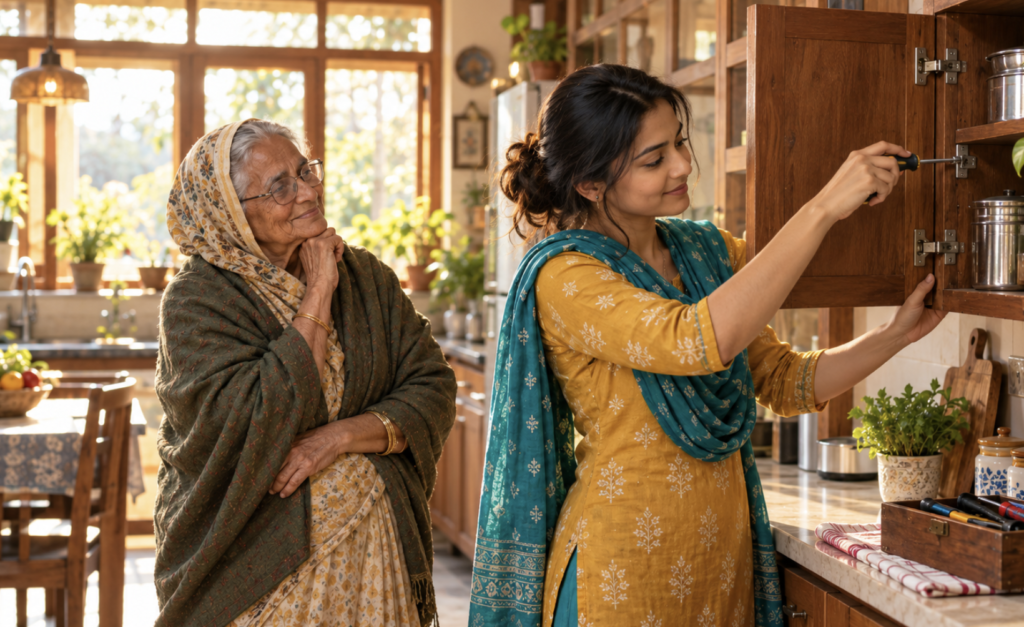
An everyday repair raises a question about how work becomes gendered. AI-generated illustration.
When I repaired my cupboard door, my mother asked, “Where are you learning this boys’ work from?”
I felt irritated. I had simply fixed something that was broken. Why did that need a gender?
That small exchange stayed with me through the Gender and Health course. When I chose the course, I wanted to understand gender identities and LGBTQ+ experiences better. I had not expected to return so often to my own life: to the work we divide at home, the futures we imagine for daughters and sons, and the care we take for granted.
By the end, I was asking how we had learned to accept these arrangements. I was also beginning to notice how easily I accepted some of them myself.
A supportive home can still carry expectations
In my first reflective journal, I described my upbringing as fairly gender neutral. My parents supported my education and encouraged me to pursue what I wanted. I still value that support. But I now recognise that encouragement and gendered expectations can exist in the same home.
As one of two daughters, I have heard people say, “Ek beta hota toh family complete hota aapka” — a son would have made your family complete. Earlier, I heard this as a suggestion that my sister and I were somehow not enough. Now, I also hear the expectations behind it. Who is assumed to carry the family name? Who is expected to care for ageing parents? Why are daughters imagined as belonging elsewhere after marriage?
My mother’s comment about the cupboard belongs within this wider pattern. Repairing is called boys’ work, while cooking and cleaning become girls’ responsibilities. I do not want to reduce my mother to one sentence. She has supported me in many ways, and she, too, grew up within these expectations. Understanding that helps me question the idea without dismissing the person.
The course gave me a way to make sense of this. A role tells us who should do something. A norm makes that arrangement seem appropriate. Power affects who can refuse and what happens when they do. Even serving water can raise a question: would a boy be expected to get up just as quickly? Could I remain seated without being called disrespectful?
The work we call help
I began noticing these expectations in the way we prepare people for marriage. Girls hear, “Doosre ghar jaogi toh adjust karna padega” — you will have to adjust when you go to another home. Boys are often spoken of as ready for marriage once they are “settled”. I now wonder how much attention we give to whether they are ready to share everyday care.
The word “help” has started to trouble me. When a father looks after his own child, we may call him a helpful husband. When the mother does the same work every day, it is treated as her responsibility. Praise can sound kind while leaving that responsibility in exactly the same place.
My field-practice proposal on musculoskeletal health has made this question more immediate. When I think about a woman living with back pain, I want to understand what her day requires of her. Can she rest? Can someone else do the lifting, cooking or childcare? Advice about caring for her body may be difficult to follow when the household continues to depend on her doing everything.
I also remember seeing a social media post asking people to respect women during Navratri. My first response was simple: why only those nine days? I now want to ask what respect means on an ordinary day, when someone needs rest or asks another family member to take over a task.

Sharing everyday care can give each family member time for their own needs. AI-generated illustration.
Health advice enters an unequal home
These reflections have changed how I imagine a public health programme. When I think of childhood vaccination, I instinctively picture a mother remembering the dates, bringing the child to the centre and following the advice. I rarely picture the father being asked the same questions. That image tells me something about my own assumptions.
As someone trained in nutrition, I have to examine this carefully. If I invite only mothers to a nutrition session, am I adding another duty to their day? What if someone else controls the food budget or decides what the household buys? A woman may understand the advice and still have little room to act on it.
The distinction between practical and strategic gender needs helped me think through this. Changing clinic timings may address an immediate difficulty. Sharing care responsibilities and supporting women’s say over money and movement can change the conditions that make attendance difficult in the first place. Both deserve attention.
I now ask similar questions about sexual and reproductive health education. Giving girls reliable information and a private space to ask questions matters. I also want to know what happens afterwards. Can they seek care confidentially? Can they make informed choices about their bodies? Do the people around them respect those choices?
The questions I carry into programme planning are therefore becoming more specific. Who has time to attend? Who needs permission? Who will take over the work at home? These details could explain why a service that appears accessible on paper is difficult to use.
The assumptions I bring with me
It would be comfortable to locate gender inequality only in other people’s behaviour. My journals make that difficult. I can support equality and still imagine that a mother should manage a child’s nutrition. Recognising that inconsistency has been uncomfortable, but it gives me something concrete to change.
My interest in gender identity and LGBTQ+ experiences remains part of this learning. I want to pay closer attention to whose experiences I include and whose voice I allow to speak for others. When a transgender person’s life is discussed, does the conversation listen to that person, or does it become an argument about whether their identity and relationships are acceptable?
I am also learning how to have these conversations within relationships I value. I do not always know when to question a remark immediately or how to respond without closing down the conversation. Understanding where an expectation comes from does not make it easy to challenge. I am still working out how to speak firmly while leaving room for reflection.
“Who has time to attend? Who needs permission? Who will take over the work at home?”
What I will ask before giving advice
As an MPH student, I want to carry this pause into my work. If someone misses an appointment or cannot follow advice, I should ask what made it difficult before deciding that they were careless. Did they have money for the journey? Could they leave home? Was there privacy? Was anyone available to share their responsibilities?
I want to bring the same care to programme design. Involving men should include sharing work and supporting women’s decisions. I also want to recognise unpaid care when I think about development. Having an income matters, but so does being able to decide how it is used and having time to look after one’s own health.
I finish the course with questions I cannot yet answer and habits I still need to change. I remain grateful to Mayur for encouraging this reflection. For me, the next step is to notice whose work I overlook, share responsibility more consciously and listen before giving advice.
“Sirf samajh lena kaafi nahi hai; apne tareeke bhi badalne padenge.” Understanding is not enough; I will have to change my own ways.
About the author
Tanvi Aditi Francis is a Master of Public Health student at Azim Premji University, Bhopal, with a background in applied nutrition and public health. Her interests include community health, nutrition and the ways gender shapes everyday care and access to health services.